How Did the Spread of Islam Affect the Development of Science?
Description: In harmony with the spirit of Islam regarding seeking knowledge, Muslims and the Islamic civilization played a crucial role in the advancement of science and technology in the world we know today.
- By islam-guide.com
- Published on 08 Mar 2006
- Last modified on 14 Oct 2021
- Printed: 1,267
- Viewed: 53,362 (daily average: 7)
- Rated by: 191
- Emailed: 16
- Commented on: 4


 Islam instructs man to use his powers of intelligence and
observation. Within a few years of the spread of Islam, great civilizations
and universities were flourishing. The synthesis of Eastern and Western ideas,
and of new thought with old, brought about great advances in medicine,
mathematics, physics, astronomy, geography, architecture, art, literature, and
history. Many crucial systems, such as algebra, the Arabic numerals, and the
concept of zero (vital to the advancement of mathematics), were transmitted to
medieval Europe from the Muslim world. Sophisticated instruments which were to
make possible the European voyages of discovery, such as the astrolabe, the
quadrant, and good navigational maps, were also developed by Muslims.
Islam instructs man to use his powers of intelligence and
observation. Within a few years of the spread of Islam, great civilizations
and universities were flourishing. The synthesis of Eastern and Western ideas,
and of new thought with old, brought about great advances in medicine,
mathematics, physics, astronomy, geography, architecture, art, literature, and
history. Many crucial systems, such as algebra, the Arabic numerals, and the
concept of zero (vital to the advancement of mathematics), were transmitted to
medieval Europe from the Muslim world. Sophisticated instruments which were to
make possible the European voyages of discovery, such as the astrolabe, the
quadrant, and good navigational maps, were also developed by Muslims.
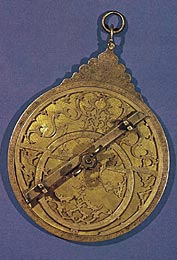
The Astrolabe: One of the most important scientific instruments developed by Muslims which was also used widely in the West until modern times.
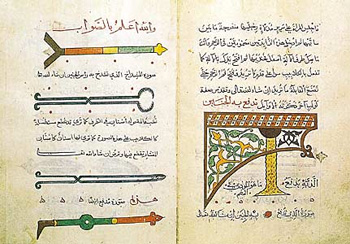
Muslim physicians paid much attention to surgery and developed many surgical instruments as seen in this old manuscript.