
The Story of Abraham (part 1 of 7): Introduction
Description: An introduction to the person of Abraham and the lofty position he holds in Judaism, Christianity, and Islam alike.
- By Imam Mufti
- Published on 27 Mar 2006
- Last modified on 29 Oct 2023
- Printed: 2,428
- Viewed: 505,752
- Rated by: 190
- Emailed: 29
- Commented on: 3


_001.jpg) One of the prophets given the most attention in the Quran
is the prophet Abraham. The Quran tells of him and his unwavering belief in
God, first calling him to reject his people and their idolatry, and later to
prove true to various tests which God places before him.
One of the prophets given the most attention in the Quran
is the prophet Abraham. The Quran tells of him and his unwavering belief in
God, first calling him to reject his people and their idolatry, and later to
prove true to various tests which God places before him.
In Islam, Abraham is seen as a strict monotheist who calls his people to the worship of God alone. For this belief, he bears great hardships, even disassociating himself with his family and people through migration to various lands. He is one who fulfills various commandments of God through which he is tested, proving true to each one.
Due to this strength of faith, the Quran attributes the one and only true religion to be the "Path of Abraham", even though prophets before him, such as Noah, called to the same faith. Because of his tireless act of obedience to God, He gave him the special title of "Khaleel", or beloved servant, not given to any other Prophet before. Due to the excellence of Abraham, God made prophets from his progeny, from them Ishmael Isaac, Jacob (Israel) and Moses, guiding people to the truth.
The lofty status of Abraham is one shared by Judaism, Christianity and Islam alike. The Jews see him to be epitome of virtue as he fulfilled all the commandments although before they were revealed, and was the first to come to the realization of the One True God. He is seen as the father of the chosen race, the father of prophets due to which God started his series of revelations. In Christianity, he is seen as the father of all believers (Romans 4:11) and his trust in God and sacrifice is taken as a model for later saints (Hebrews 11).
As Abraham is given such importance, it is worthy that one study his life and investigate those aspects which raised him to the level which God gave him.
Although the Quran and the Sunnah do not given the details of the whole life of Abraham, they do mention certain facts worthy of note. As with other Quranic and biblical figures, the Quran and Sunnah detail aspects of their lives as a clarification of some misguided beliefs of previous revealed religions, or those aspects which contain certain mottos and morals worthy of note and emphasis.
His Name
In the Quran, the only name given to Abraham is "Ibraheem" and "Ibrahaam", all sharing the original root, b-r-h-m. Although in the Bible Abraham is known as Abram at first, and then God is said to change his name to Abraham, the Quran has kept silent on this subject, neither affirming nor negating it. Modern Judeo-Christian scholars do doubt, however, in story of the changing of his names and their respective meanings, calling it "popular world play". Assyriologists suggest that the Hebrew letter Hê (h) in the Minnean dialect is written in stead of a long ‘a’ (ā), and that the difference between Abraham and Abram is merely dialectical.[1] The same can be said for the names Sarai and Sarah, as their meanings are also identical.[2]
His Homeland
Abraham is estimated to have been born 2,166 years before Jesus in or around the Mesopotamian[3] city of Ur[4], 200 miles southeast of present-day Baghdad[5]. His father was ‘Aazar’, ‘Terah’ or ‘Terakh’ in the Bible, an idol worshipper, who was from the descendants of Shem, the son of Noah. Some scholars of exegesis suggest that he may have been called Azar after an idol he was devoted to.[6] He is likely to have been Akkadian, a Semitic people from the Arabian Peninsula who settled in Mesopotamia sometime in the third millennium BCE.
It seems as if Azar migrated along with some of his relatives to the city of Haran in the early childhood of Abraham before the confrontation with his people, although some Judeo-Christian traditions[7] tell it to be later in his life after he is rejected in his native city. In the Bible, Haran, one of the brothers of Abraham is said to have died in Ur, "in the land of his nativity" (Genesis 11:28), but he was much older than Abraham, as his other brother Nahor takes Haran’s daughter as a wife (Genesis 11:29). The bible also makes no mention of the migration of Abraham to Haran, rather the first command to migrate is that out of Haran, as if they had settled there before (Genesis 12:1-5). If we take the first command to mean the emigration from Ur to Canaan, there seems to be no reason that Abraham would dwell with his family in Haran, leaving his father there and proceeding to Canaan thereafter, not to mention its geographical improbability [See map].
The Quran does mention the migration of Abraham, but it does so after Abraham disassociates himself from his father and tribesmen due to their disbelief. If he had been in Ur at that time, it seems unlikely that his father would go with him to Haran after disbelieving and torturing him along with his townspeople. As to why they chose to migrate, archaeological evidence suggests that Ur was a great city which saw its rise and fall within the lifetime of Abraham[8], so they may have been forced to leave due to environmental hardships. They may have chosen Haran due to it sharing the same religion as Ur[9].
_002.jpg)
The Religion of Mesopotamia
Archeological discoveries from the time of Abraham paint a vivid picture of the religious life of Mesopotamia. Its inhabitants were polytheists who believed in a pantheon, in which each god had a sphere of influence. The large temple dedicated to the Akkadian[10] moon god, Sin, was the main centre of Ur. Haran also had the moon as the central godhead. This temple was believed to be the physical home of God. The chief god of the temple was a wooden idol with additional idols, or ‘gods’, to serve him.
_003.jpg)
The Great Ziggurat of Ur, the temple of moon god Nanna, also known as Sin. Shot in 2004, the photograph is courtesy of Lasse Jensen.
Knowledge of God
Although Judeo-Christian scholars have differed as to when Abraham came to know God, at the age of three, ten, or forty-eight[11], the Quran is silent in mentioning the exact age at which Abraham received his first revelation. It seems it was, however, when he was young in age, as the Quran calls him a young man when his people try to execute him for rejecting their idols, and Abraham himself said to have knowledge not available to his father when he called him to worship God alone before his call spread to his people (19:43). The Quran is clear, however, in saying that he was one of the prophets to whom a scripture was revealed:
"Verily! This is in the former Scriptures. The Scriptures of Abraham and Moses." (Quran 87:18-19)
Footnotes:
[1] Abraham. The Catholic Encyclopedia, Volume I. Copyright © 1907 by Robert Appleton Company. Online Edition Copyright © 2003 by K. Knight Nihil Obstat, March 1, 1907. Remy Lafort, S.T.D., Censor. Imprimatur. +John Cardinal Farley, Archbishop of New York. (http://www.newadvent.org/cathen/01051a.htm)
[2] Sarah. The Catholic Encyclopedia, Volume I. Copyright © 1907 by Robert Appleton Company. Online Edition Copyright © 2003 by K. Knight Nihil Obstat, March 1, 1907. Remy Lafort, S.T.D., Censor. Imprimatur. +John Cardinal Farley, Archbishop of New York.) (Abraham. Charles J. Mendelsohn, Kaufmann Kohler, Richard Gottheil, Crawford Howell Toy. The Jewish Encyclopedia.
[3] Mesopotamia:
"(Mes·o·po·ta·mi·a) An ancient region of southwest Asia between the Tigris and
Euphrates rivers in modern-day Iraq. Probably settled before 5000 B.C., the
area was the home of numerous early civilizations, including Sumer, Akkad, Babylonia, and Assyria." (The American Heritage® Dictionary of the English
Language, Fourth Edition
Copyright © 2000 by Houghton Mifflin Company.)
[4] The ancestor of the Hebrew people, Abram, was, we are told, born at "Ur of the Chaldees." "Chaldees" is a mistranslation of the Hebrew Kasdim, Kasdim is the Old Testament name of the Babylonians, while the Chaldees were a tribe who lived on the shores of the Persian Gulf, and did not become a part of the Babylonian population till the time of Hezekiah. Ur was one of the oldest and most famous of the Babylonian cities. Its site is now called Mugheir, or Mugayyar, on the western bank of the Euphrates, in Southern Babylonia. (Easton’s 1897 Bible Dictionary). Some Judeo-Christian scholars say that the "Ur-Kasdim" mentioned in the Bible is nor Ur, but actually the city of Ur-Kesh, located in northern Mesopotamia and closer to Haran (From Abraham to Joseph - The historical reality of the Patriarchal age. Claus Fentz Krogh. (http://www.genesispatriarchs.dk/patriarchs/abraham/abraham_eng.htm).
[5] Ibn Asakir, a famous Muslim scholar and historian, also authenticated this opinion and said that he was born in Babylon. See "Qisas al-Anbiyaa" ibn Katheer.
[6] Stories of the Prophets, ibn Katheer. Darussalam Publications.
[7] Since there is little detail about the life of Abraham in the bible, much of what is commonly believed about Abraham is formed through various Judeo-Christian traditions, collected in the Talmud and other rabbinical writings. Much of what is mentioned in the bible as well as other traditions is regarded amongst Judeo-Christian scholars as legends, much of which cannot be substantiated. (Abraham. The Catholic Encyclopedia, Volume I. Copyright © 1907 by Robert Appleton Company. Online Edition Copyright © 2003 by K. Knight Nihil Obstat, March 1, 1907. Remy Lafort, S.T.D., Censor. Imprimatur. +John Cardinal Farley, Archbishop of New York.) (Abraham. Charles J. Mendelsohn, Kaufmann Kohler, Richard Gottheil, Crawford Howell Toy. The Jewish Encyclopedia. (http://www.jewishencyclopedia.com/view.jsp?artid=360&letter=A#881)
[8] (http://www.myfortress.org/archaeology.html)
[9] (http://www.myfortress.org/archaeology.html)
[10]
Akkad: "(Ak·kad) An ancient region of Mesopotamia occupying the northern part
of Babylonia." (The American Heritage® Dictionary of the English
Language, Fourth Edition
Copyright © 2000 by Houghton Mifflin Company.)
[11] Gen R. xxx. Abraham. Charles J. Mendelsohn, Kaufmann Kohler, Richard Gottheil, Crawford Howell Toy. The Jewish Encyclopedia. (http://www.jewishencyclopedia.com/view.jsp?artid=360&letter=A#881).
The Story of Abraham (part 2 of 7): A Call to His People
Description: Abraham invites his father Azar (Terah or Terakh in the Bible) and nation to the Truth revealed to him from his Lord.
- By Imam Mufti
- Published on 27 Mar 2006
- Last modified on 28 Jan 2022
- Printed: 2,158
- Viewed: 293,284
- Rated by: 166
- Emailed: 9
- Commented on: 1
Abraham and His Father
Like those around him, Abraham’s father Azar (Terah or Terakh in the Bible), was an idol worshipper. Biblical tradition[1] tells of him actually being a sculptor of them,[2] hence Abraham’s first call was directed to him. He addressed him with clear logic and sense, understood by a young man like himself as well as the wise.
"And mention in the Book (the Quran) Abraham, indeed he was a man of truth, a Prophet. When he said to his father: "O my father! Why do you worship that which hears not, sees not and cannot avail you in anything? O my father! Verily! There has come to me of knowledge that which came not unto you. So follow me. I will guide you to a Straight Path." (Quran 19:41-43)
The reply from his father was rejection, an obvious reply by any person challenged by another much younger than them, a challenge made against years of tradition and norm.
"He (the father) said: ‘Do you reject my gods, O Abraham? If you do not stop, I will indeed stone you. So get away from me safely before I punish you.’" (Quran 19:46)
Abraham and His People
After incessant attempts in calling his father to leave the worship of false idols, Abraham turned to his people seeking to warn others, addressing them with the same simple logic.
"And recite to them the story of Abraham. When he said to his father and his people: "What do you worship?" They said: "We worship idols, and to them we are ever devoted." He said: "Do they hear you, when you call (on them)? Or do they benefit you or do they harm (you)?" They said: "Nay, but we found our fathers doing so." He said: "Do you observe that which you have been worshipping, you and your ancient fathers? Verily! They are enemies to me, save the Lord of all that exists; Who has created me, and it is He Who guides me; And it is He Who feeds me and gives me to drink. And when I am ill, it is He who cures me; And Who will cause me to die, and then will bring me to life (again)." (Quran 26:69-81)
In furthering his call that the only deity which deserved worship was God, Almighty, he struck another example for his people to ponder. The Judeo-Christian tradition tells a similar story, but portrays it in the context of Abraham himself coming to the realization if God through the worship of these beings[3], not of him using it as an example for his people. In the Quran, none of the Prophets are said to have associated others than God, even if they were uninformed of the correct way before they were commissioned as prophets. The Quran tells of Abraham:
"When the night grew dark upon him, he beheld a star, and said, ‘This is my Lord!’ But when it set, he said: ‘I love not things that set.’" (Quran 6:76)
Abraham put forth to them the example of the stars, a creation truly incomprehensible to humans at time, seen as something greater than humanity, and many times having various powers attributed to them. But in the setting of the stars Abraham saw their inability to appear as they desired, but rather only at night.
He then struck the example of something even greater, a heavenly body more beautiful, larger, and that could appear at daytime as well!
"And when he saw the moon rising up, he exclaimed: ‘This is my Lord.’ But when it set, he said: ‘Unless my Lord guides me, I surely shall become one of the folk who are astray.’" (Quran 6:77)
Then as his culminating example, he struck an example of something even bigger, one of the most powerful of creation, one without which life itself was an impossibility.
"And when he saw the sun rising, he cried: ‘This is my Lord! This is greater!’ But when the sun set, he said, ‘O my people! Surely I am free from that which you associate with God. Verily, I have turned my face towards Him Who has created the heavens and the earth, away from idolatry, and I am not of those who associate others with God.’" (Quran 6:78-79)
Abraham proved to them that the Lord of the worlds was not to be found in the creations that their idols represented, but was, rather, the entity who created them and everything which they could see and perceive; that the Lord does not necessarily need to be seen in order to be worshipped. He is an All-Able Lord, not bound by limitations as the creations found in this world are. His message was simple:
"Worship God, and keep your duty to Him; that is better for you if you did but know. You worship instead of God only idols, and you only invent a lie. Lo! Those whom you worship instead of God own no provision for you. So seek your provision from God, and worship Him, and give thanks to Him, (for) to Him you will be brought back." (Quran 29:16-17)
He openly questioned their adherence to mere traditions of their forefathers,
"He said: ‘Verily you and your fathers were in plain error.’"
Abraham’s path was to be filled with pain, hardship, trial, opposition, and heartache. His father and people rejected his message. His call fell on deaf ears; they would not reason. Instead, he was challenged and mocked,
"They said: ‘Bring you to us the truth, or are you some jester?’"
In this stage in his life, Abraham, a young man with a prospective future, opposes his own family and nation in order to propagate a message of true monotheism, belief in the One True God, and rejection of all other false deities, whether they be stars and other celestial or earthly creations, or depictions of gods in the form of idols. He was rejected, outcaste and punished for this belief, but he stood firm against all evil, ready to face even more in the future.
"And (remember) when his (Abraham’s) Lord tried Abraham with (various) commandments, to which he proved true..." (Quran 2:124)
Footnotes:
[1] Gen r. xxxviii, Tanna debe Eliyahu. Ii. 25.
[2] Abraham. Charles J. Mendelsohn, Kaufmann Kohler, Richard Gottheil, Crawford Howell Toy. The Jewish Encyclopedia. (http://www.jewishencyclopedia.com/view.jsp?artid=360&letter=A#881)
[3] The Talmud: Selections, H. Polano. (http://www.sacred-texts.com/jud/pol/index.htm).
The Story of Abraham (part 3 of 7): The Iconoclast
Description: Abraham destroys the idols of his people in order to prove to them the futility of their worship.
- By Imam Mufti
- Published on 27 Mar 2006
- Last modified on 25 Jun 2019
- Printed: 2,001
- Viewed: 279,654
- Rated by: 165
- Emailed: 7
- Commented on: 0
Then the time came when preaching had to be accompanied with physical action. Abraham planned a bold and decisive blow at idolatry. The Quranic account is slightly different than what is mentioned in Judeo-Christian traditions, as they say for Abraham to have destroyed his father’s personal idols.[1] The Quran tells that he destroyed the idols of his people, kept at a religious altar. Abraham had hinted at a plan involving the idols:
"And, by God, I shall circumvent your idols after you have gone away and turned your backs." (Quran 21:57)
It was time for a religious festival, perhaps dedicated to Sin, for which they left the town. Abraham was invited to attend the festivities, but he excused himself,
"And he glanced a glance at the stars. Then said: ‘Lo! I feel sick!’"
So, when his peers left without him, it became his opportunity. As the temple was deserted, Abraham made his way there and approached the gold-plated wooden idols, which had had elaborate meals left in front of them by the priests. Abraham mocked them in disbelief:
"Then turned he to their gods and said: ‘Will you not eat? What ails you that you speak not?’"
After all, what could have deluded man to worship gods of his own carving?
"Then he attacked them, striking with his right hand."
The Quran tells us:
"He reduced them to fragments, all except the chief of them."
When the temple priests returned, they were shocked to see the sacrilege, the destruction of the temple. They were wondering who could have done this to their idols when someone mentioned the name of Abraham, explaining that he used to speak ill of them. When they called him to their presence, it was for Abraham to show them their foolishness:
"He said: ‘Worship you that which you yourselves do carve when God has created you and what you make?’"
Their anger was mounting; in no mood for being preached to, they got straight to the point:
"Is it you who has done this to our gods, O Abraham?"
But Abraham had left the largest idol untouched for a reason:
"He said: ‘But this, their chief has done it. So question them, if they can speak!’"
When Abraham so challenged them, they were cast into confusion. They blamed each other for not guarding the idols and, refusing to meet his eyes, said:
"Indeed you know well these speak not!"
So Abraham pressed his case.
"He said: ‘Worship you then instead of God that which cannot profit you at all, nor harm you? Fie on you and all that you worship instead of God! Have you then no sense?’"
The accusers had become the accused. They were accused of logical inconsistency, and so had no answer for Abraham. Because Abraham’s reasoning was unanswerable, their response was rage and fury, and they condemned Abraham to be burned alive,
"Build for him a building and fling him in the red hot fire."
The townspeople all helped in gathering wood for the fire, until it was the largest fire they had ever seen. The young Abraham submitted to the fate chosen for him by the Lord of the Worlds. He did not loose faith, rather the trial made him stronger. Abraham did not flinch in the face of a fiery death even at this tender age; rather his last words before entering it were,
"God is sufficient for me and He is the best disposer of affairs." (Saheeh Al-Bukhari)
Here again is an example of Abraham proving true to the trials he faced. His belief in the True God was tested here, and he proved that he was even prepared to surrender his existence to the call of God. His belief was evidenced by his action.
God had not willed that this be the fate of Abraham, for he had a great mission ahead of him. He was to be the father of some of the greatest prophets known to humanity. God saved Abraham as a sign for him and his people as well.
"We (God) said: ‘O fire, be coolness and peace for Abraham.’ And they wished to set a snare for him, but We made them the greater losers."
Thus did Abraham escape the fire, unharmed. They tried to seek revenge for their gods, but they and their idols were in the end humiliated.
The Story of Abraham (part 4 of 7): His Migration to Canaan
Description: Abraham’s dispute with a king, and the command of God to migrate to Canaan.
- By Imam Mufti
- Published on 27 Mar 2006
- Last modified on 28 Jan 2022
- Printed: 2,044
- Viewed: 313,068
- Rated by: 163
- Emailed: 5
- Commented on: 1
Modern archeological discoveries suggest the high priestess was the emperor’s daughter. Naturally, she would have made a point to make an example of the man who defiled her temple. Soon Abraham, still a young man[1], found himself on trial, standing all alone in front of a king, most probably King Nimrod. Even his father was not on his side. But God was, as He always had been.
Dispute with a King
While Judeo-Christian traditionists clearly assert that Abraham was sentenced to the fire by the king, Nimrod, the Quran does not elucidate this matter. It does however mention the dispute which a king had with Abraham, and some Muslim scholars suggest that it was this same Nimrod, but only after an attempt was made by the masses to kill Abraham[2]. After God had saved Abraham from the fire, his case was presented to the king, who out of him pompousness, vied with God himself due to his kingdom. He debated with the young man, as God tells us:
"Have you not considered him who had an argument with Abraham about his Lord, because God had given him the kingdom?" (Quran 2:258)
Abraham’s logic was undeniable,
"‘My Lord is He Who gives life and causes death.’ He answered: ‘I give life and cause death.’" (Quran 2:258)
The king brought forth two men sentenced to death. He freed one and condemned the other. This reply of the king was out of the context and utterly stupid, so Abraham put forth another, one which would surely silence him.
"Abraham said: ‘Lo! God causes the sun to rise in the east, so you cause it to come up from the west.’ Thus was the disbeliever absolutely defeated. And God guides not wrongdoing folk." (Quran 2:258)
Abraham in Migration
After years of ceaseless calling, faced with the rejection of his people, God commanded Abraham to disassociate from his family and people.
Indeed there has been an excellent example for you in Abraham and those with him, when they said to their people: "Verily, we are free from you and whatever you worship besides God, we have rejected you, and there has started between us and you, hostility and hatred forever, until you believe in God Alone." (Quran 60:4)
At least two persons in his family did, however, accept his exhortation - Lot, his nephew, and Sarah, his wife. Thus, Abraham migrated along with the other believers.
"So Lot believed in him (Abraham). He (Abraham) said: ‘I will emigrate for the sake of my Lord. Verily, He is the All-Mighty, the All-Wise.’" (Quran 29:26)
They migrated together to a blessed land, the land of Canaan, or Greater Syria where, according to Judeo-Christian traditions, Abraham and Lot divided their people west and east of the land they had migrated to[3].
"And We rescued him and Lot to the land which We have blessed for the worlds." (Quran 21:71)
It was here, in this blessed land, that God chose to bless Abraham with progeny.
"…We (God) bestowed upon him Isaac, and (a grandson) Jacob. Each one We made righteous." (Quran 21:72)
"And that was Our Proof which We gave Abraham against his people. We raise whom We will in degrees. Certainly your Lord is All Wise, All Knowing. And We bestowed upon him Isaac and Jacob, each of them We guided, and before him, We guided Noah, and among his progeny David, Solomon, Job, Joseph, Moses, and Aaron. Thus do We reward the good doers. And Zachariah, and John and Jesus and Elias, each one of them was of the righteous. And Ishmael and Elisha, and Jonah and Lot, and each one of them We preferred above the worlds (of men and jinn). And also some of their fathers and their progeny and their brethren, We chose them, and We guided them to a Straight Path. This is the Guidance of God with which He guides whomsoever He will of His slaves. But if they had joined in worship others with God, all that they used to do would have been of no benefit to them. They are those whom We gave the Book, the Understanding, and Prophethood…" (Quran 6:83-89)
Prophets, chosen for the guidance of his nation:
"And We made them leaders, guiding (humankind) by Our Command, and We inspired in them the doing of good deeds, performing prayers, and the giving of Zakat and of Us (Alone) they were worshippers." (Quran 21:73)
The Story of Abraham (part 5 of 7): The Gifting of Hagar and Her Plight
Description: Some accounts of Abraham’s journey to Egypt, the birth of Ishmael, and Hagar’s venture in Paran.
- By Imam Mufti
- Published on 03 Apr 2006
- Last modified on 25 Jun 2019
- Printed: 2,213
- Viewed: 359,137
- Rated by: 166
- Emailed: 14
- Commented on: 0
Abraham in Canaan & Egypt
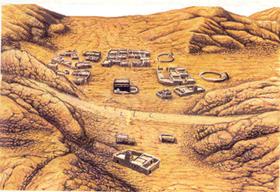 Abraham stayed in Canaan for several years going from
city to city preaching and inviting people to God until a famine forced him and
Sarah to migrate to Egypt. In Egypt was a despotic Pharaoh who had the passionate
desire to take possession of married women.[1]
This Islamic account is strikingly different than Judeo-Christian traditions,
which say that Abraham claimed that Sarah[2]
was his sister in order to save himself from the Pharaoh[3].
The Pharaoh took Sarah into his harem and honored Abraham for it, but when his house
was stricken with severe plagues, he came to know that she was the wife of
Abraham and chastised him for not telling him so, thus banishing him from Egypt.[4]
Abraham stayed in Canaan for several years going from
city to city preaching and inviting people to God until a famine forced him and
Sarah to migrate to Egypt. In Egypt was a despotic Pharaoh who had the passionate
desire to take possession of married women.[1]
This Islamic account is strikingly different than Judeo-Christian traditions,
which say that Abraham claimed that Sarah[2]
was his sister in order to save himself from the Pharaoh[3].
The Pharaoh took Sarah into his harem and honored Abraham for it, but when his house
was stricken with severe plagues, he came to know that she was the wife of
Abraham and chastised him for not telling him so, thus banishing him from Egypt.[4]
Abraham had known that Sarah would catch his attention, so he told her that if the Pharaoh asked her, that she should say that she is the sister of Abraham. When they entered his kingdom, as expected, the Pharaoh asked about his relationship with Sarah, and Abraham replied that she was his sister. Although the answer did alleviate some of his passion, he still took her captive. But the protection of the Almighty saved her from his evil plot. When Pharaoh summoned Sarah to act on his demented passions, Sarah turned to God in prayer. The moment Pharaoh reached for Sarah, his upper body stiffened. He cried to Sarah in distress, promising to release her if she would pray for his cure! She prayed for his release. But only after a failed third attempt did he finally desist. Realizing their special nature, he let her go and returned her to her supposed brother.
Sarah returned while Abraham was praying, accompanied by gifts from the Pharaoh, as he had realized their special nature, along with his own daughter Hagar as well, according to Judeo-Christian traditions, as a handmaiden[5]. She had delivered a powerful message to the Pharaoh and the pagan Egyptians.
After they had returned to Palestine, Sarah and Abraham continued to be childless, despite divine promises that he would be granted a child. As the gifting of a handmaid by a barren woman to her husband in order to produce offspring seems to be a common practice of that day[6], Sarah suggested to Abraham that he take Hagar as his concubine. Some Christian scholars say of this event that he actually took her as his wife[7]. Whichever case it may be, in Jewish and Babylonian tradition, any offspring born to a concubine would be claimed by the concubine’s former mistress and be treated exactly the same as a child born to her[8], including matters of inheritance. While in Palestine, Hagar bore him a son, Ishmael.
Abraham in Mecca
When Ishmael was still nursing, God yet again chose to test the faith of his beloved Abraham and commanded him to take Hagar and Ishmael to a barren valley of Bakka 700 miles southeast of Hebron. In later times it would be called Mecca. Indeed it was a great test, for he and his family had longed for such a time for offspring, and when their eyes were filled with the joy of an heir, the commandment was enacted to take him to a distant land, one known for its barrenness and hardship.
While the Quran affirms that this was yet another test for Abraham while Ishmael was still a baby, the Bible and Judeo-Christian traditions assert that it was a result of the rage of Sarah, who requested Abraham to banish Hagar and her son when she saw Ishmael "mocking"[9] at Isaac[10] after he was weaned. Since the typical age for weaning, at least in Jewish tradition, was 3 years[11], this suggests that Ishmael was approximately 17 years of age[12] when this event occurred. It seems logically impossible, that Hagar would be able to carry a young man on her shoulders and take him hundreds of miles until she had reached Paran, only then laying him, as the Bible says, down under a bush[13]. In these verses Ishmael is referred to by a different word than the one used describing his banishment. This word indicates that he was a very young boy, possibly a baby, rather than a youth.
So Abraham, after having sojourned with Hagar and Ishmael, left them there with a skin of water and leather bag full of dates. As Abraham began walking away leaving them behind, Hagar became anxious as to what was happening. Abraham did not look back. Hagar chased him, ‘O Abraham, where are you going, leaving us in this valley where there is no person whose company we can enjoy, nor is there anything here?’
Abraham hurried his pace. Finally, Hagar asked, ‘Has God asked you to do so?’
Suddenly, Abraham stopped, turned back and said, ‘Yes!’
Feeling a degree of comfort in this answer, Hagar asked, ‘O Abraham, to whom are you leaving us?’
‘I am leaving you to God’s care,’ Abraham replied.
Hagar submitted to her Lord, ‘I am satisfied to be with God!’[14]
While she traced her way back to little Ishmael, Abraham proceeded until he reached a narrow pass in the mountain where they would not be able to see him. He stopped there and invoked God in prayer:
"Our Lord! I have settled some of my offspring in a valley barren from any cultivation, by you Sacred House, our Lord, so they may establish the prayer. So make the hearts of people yearn towards them, and provide them with all types of fruits that they may be grateful." (Quran 14:37)
Soon, the water and dates were gone and Hagar’s desperation increased. Unable to quench her thirst or to breastfeed her little baby, Hagar began searching for water. Leaving Ishmael under a tree, she began climbing the rocky incline of a nearby hill. ‘Maybe there is a caravan passing by,’ she thought to herself. She ran between the two hills of Safa and Marwa seven times looking for signs of water or help, later personified by all Muslims in Hajj. Fatigued and distraught, she heard a voice, but could not locate its source. Then, looking down in the valley, she saw an angel, who is identified as Gabriel in Islamic sources[15], standing next to Ishmael. The angel dug into the ground with his heel next to the baby, and water came gushing out. It was a miracle! Hagar tried to make a basin around it to keep it from flowing out, and filled her skin.[16] ‘Do not be afraid of being neglected,’ the angel said, ‘for this is the House of God which will be built by this boy and his father, and God never neglects his people.’[17] This well, called Zamzam, is flowing to this day in the city if Mecca in the Arabian Peninsula.
It was not long afterwards that the tribe of Jurham, moving from southern Arabia, stopped by the valley of Mecca after seeing the unusual sight of a bird flying in its direction, which could only mean the presence of water. They eventually settled in Mecca and Ishmael grew up among them.
A similar account of this well is given in the Bible in Genesis 21. In this account, the reason for moving away from the babe was to avoid seeing him die rather than a search for help. Then, after the baby had begun wailing with thirst, she asked God to relieve her of seeing him die. The appearance of the well was said to be in response to the crying of Ishmael, rather than her supplication, and no effort from Hagar to find help is reported there. Also, the Bible tells that the well was in the wilderness of Paran, where they dwelt afterwards. Judeo-Christian scholars often mention that Paran is somewhere north of the Sinai Peninsula, due to the mention of Mt. Sinai in Deuteronomy 33:2. Modern biblical archaeologists, however, say that Mt. Sinai is actually in modern day Saudi Arabia, which necessitates that Paran be there as well.[18]
Footnotes:
[1] Fath al-Bari.
[2] Although Sarah was his half sister according to Genesis 20:12, making his marriage incestual, Islamic sources such as al-Bukhari, assert that this was one of the three times in which Abraham had made a deceptive statement, as Sarah was his sister in faith and humanity, in order to ward off a greater evil.
[3] In addition to traditions, a less detailed story is also mentioned in the Bible, Genesis.12.11-20.
[4] Sarah. Emil G. Hirsch, Wilhelm Bacher, Jacob Zallel Lauterbach, Joseph Jacobs and Mary W. Montgomery. (http://www.jewishencyclopedia.com/view.jsp?artid=245&letter=S). Abraham. Charles J. Mendelsohn, Kaufmann Kohler, Richard Gottheil, Crawford Howell Toy. The Jewish Encyclopedia. See also Genesis: 12:14-20.
[5] Sarah. Emil G. Hirsch, Wilhelm Bacher, Jacob Zallel Lauterbach, Joseph Jacobs and Mary W. Montgomery. (http://www.jewishencyclopedia.com/view.jsp?artid=245&letter=S). Abraham. Charles J. Mendelsohn, Kaufmann Kohler, Richard Gottheil, Crawford Howell Toy. The Jewish Encyclopedia.
[6] Pilegesh. Emil G. Hirsch and Schulim Ochser. The Jewish Encyclopedia. (http://www.jewishencyclopedia.com/view.jsp?artid=313&letter=P&search=pilegesh).
[7] (http://whosoeverwill.ca/womenscripturehagar.htm, http://www.1timothy4-13.com/files/proverbs/art15.html).
[8] (http://www.studylight.org/com/acc/view.cgi?book=ge&chapter=016).
[9] Genesis 21:9.
[10] Ishmael. Isidore Singer, M. Seligsohn, Richard Gottheil and Hartwig Hirschfeld. The Jewish Encyclopedia. (http://www.jewishencyclopedia.com/view.jsp?artid=277&letter=I).
[11] 2Mac 7:27, 2 Chronicles 31:16.
[12] Abraham is 86 at the birth of Ishmael (Genesis:16:16), and 100 at the birth of Isaac (Genesis 21:5).
[13] Genesis 21:15.
[14] Saheeh Al-Bukhari.
[15] Musnad Ahmad
[16] A similar account is mentioned in the Bible, although its details are quite different. See Genesis 21:16-19
[17] Saheeh Al-Bukhari
[18]Is Mount SINAI in the SINAI? B.A.S.E. Institute. (http://www.baseinstitute.org/Sinai_1.html).
The Story of Abraham (part 6 of 7): The Greatest Sacrifice
Description: The test of his lifetime, Abraham sees in a dream that he must sacrifice his “only son”, but is it Isaac or Ishmael?
- By Imam Mufti
- Published on 03 Apr 2006
- Last modified on 25 Jun 2019
- Printed: 2,121
- Viewed: 352,674
- Rated by: 177
- Emailed: 6
- Commented on: 1
Abraham Sacrifices His Son
It had been close to ten years since Abraham had left his wife and baby in Mecca in the care of God. After a two month journey, he was surprised to find Mecca a lot different than how he had left it. The joy of reunion was soon interrupted by a vision which was to be the ultimate test of his faith. God commanded Abraham through a dream to sacrifice his son, the son he had had after years of prayers and had just met after a decade of separation.
We know from the Quran that the child to be sacrificed was Ishmael, as God, when giving the glad tidings of the birth of Isaac to Abraham and Sarah, also gave the glad tidings of a grandson, Jacob (Israel):
"…But we gave her glad tidings of Isaac, and after him, of Jacob." (Quran 11:71)
Similarly, in the biblical verse Genesis 17:19, Abraham was promised:
"Your wife Sarah shall bear you a son whose name shall be Isaac. I will establish my covenant with him as an everlasting covenant [and] with his seed after him."
Because God promised to give Sarah a child from Abraham and grandchildren from that child, it is neither logically nor practically possible for God to command Abraham to sacrifice Isaac, since God neither breaks his promise, nor is He the "author of confusion."
Although Isaac’s name is explicitly mention as the one who was to be sacrificed in Genesis 22:2, we learn from other Biblical contexts that it is clear interpolation, and the one to be slaughtered was Ishmael.
"Thine Only Son"
In the verses of Genesis 22, God commands Abraham to sacrifice his only son. As all scholars of Islam, Judaism and Christianity agree, Ishmael was born before Isaac. From this, it would not be fit to call Isaac the only son of Abraham.
It is true that Judeo-Christian a scholars often argue that since Ishmael was born to a concubine, he is not a legitimate son. However, we have already mentioned earlier that according to Judaism itself, the gifting of concubines from barren wives to their husbands in order to produce offspring was a common, valid and acceptable occurrence, and the child produced by the concubine would be claimed by the wife of the father[1], enjoying all rights as her, the wife’s, own child, including inheritance. Furthermore, they would receive a double the share of other children, even if they were "hated"[2].
In addition to this, it is inferred in the Bible that Sarah herself would regard a child born to Hagar as a rightful heir. Knowing that Abraham had been promised that his seed would fill the land between the Nile and the Euphrates (Genesis 15:18) from his own body (Genesis 15:4), she offered Hagar to Abraham in order that she be the means to fulfill this prophecy. She said,
"Behold now, the Lord hath restrained me from bearing: I pray thee, go in unto my maid; it may be that I may obtain children by her." (Genesis 16:2)
This is also similar to Leah and Rachel, the wives of Jacob son of Isaac, giving their maids to Jacob to produce offspring (Genesis 30:3, 6. 7, 9-13). Their children were Dan, Nepthali, Gad and Asher, who were from the twelve sons of Jacob, the fathers of the twelve tribes of Israelites, and therefore valid heirs[3].
From this, we understand that Sarah believed that a child born to Hagar would be a fulfillment of the prophecy given to Abraham, and be as if he was born to her own self. Thus, according to this fact alone, Ishmael is not illegitimate, but a rightful heir.
God Himself regards Ishmael as a valid heir, for, in numerous places, the Bible mentions that Ishmael is a "seed" of Abraham. For example, in Genesis 21:13:
"And also of the son of the bondwoman will I make a nation, because he is thy seed.
There are many other reasons which prove that it was Ishmael and not Isaac who was to be sacrificed, and God willing, a separate article will be dedicated to this issue.
To continue with the account, Abraham consulted his son to see if he understood what he was commanded by God,
"So We gave him the good news of a forbearing son. And when (his son) was old enough to help in his daily affairs, (Abraham) said: O my dear son, I have seen in a dream that I must sacrifice you. So look, what think you? He said: O my father! Do that which you are commanded. God willing, you shall find me of the patient." (Quran 37:101-102)
Indeed if a person was told by their father that they were to be killed due to a dream, it would not be taken in the best of manners. One may doubt the dream as well as the sanity of the person, but Ishmael knew the station of his father. The pious son of a pious father was committed to submit to God. Abraham took his son to the place where he was to be sacrificed and laid him face down. For this reason, God has described them in the most beautiful of words, painting a picture of the essence of submission; one which brings tears to the eyes:
"And when they both submitted (to the command of God), and he (Abraham) laid him (Ishmael) face down upon his forehead (in order to be sacrificed)." (Quran 37:103)
Just as Abraham’s knife was poised to descend, a voice stopped him
"We called to him: O Abraham: You have indeed fulfilled the vision. Lo! Thus do We reward the good. Lo! That verily was a clear test." (Quran 37:104-106)
Indeed, it was the greatest test of all, the sacrificing of his only child, one born to him after he had reached an old age and years of longing for progeny. Here, Abraham showed his willingness to sacrifice all his belongings for God, and for this reason, he was designated a leader of all humanity, one whom God blessed with a progeny of Prophets.
"And when his God tested Abraham with various commands, and he proved true to each one." He (God) said, indeed I have made you a leader of humanity. He (Abraham) said (requesting of God), ‘and from my progeny." (Quran 2:124)
Ishmael was ransomed with a ram,
‘…then We redeemed him with a momentous sacrifice.’ (Quran 37:107)
It is this epitome of submission and trust in God which hundreds of millions of Muslims reenact every year during the days of Hajj, a day called Yawm-un-Nahr – The Day of Sacrifice, or Eid-ul-Adhaa - or the Celebration of Sacrifice.
Abraham returned to Palestine, and upon doing so, he was visited by angels who give him and Sarah the good news of a son, Isaac,
"Lo! We bring you good tidings of a boy possessing wisdom." (Quran 15:53)
It is at this time that he is also told about the destruction of the people of Lot.
Footnotes:
[1] Pilegesh. Emil G. Hirsch and Schulim Ochser. The Jewish Encyclopedia. (http://www.jewishencyclopedia.com/view.jsp?artid=313&letter=P).
[2] Deuteronomy 21:15-17. See also: Primogeniture. Emil G. Hirsch and I. M. Casanowicz. The Jewish Encyclopedia. (http://www.jewishencyclopedia.com/view.jsp?artid=527&letter=P).
[3] Jacob. Emil G. Hirsch, M. Seligsohn, Solomon Schechter and Julius H. Greenstone. The Jewish Encyclopedia. (http://www.jewishencyclopedia.com/view.jsp?artid=19&letter=J).
The Story of Abraham (part 7 of 7): The Building of a Sanctuary
Description: Abraham again visits his son Ishmael, but this time to fulfill a momentous task, the building of a House of Worship, a sanctuary for all of humanity.
- By IslamReligion.com
- Published on 04 Apr 2006
- Last modified on 28 Jan 2022
- Printed: 2,383
- Viewed: 317,038
- Rated by: 175
- Emailed: 41
- Commented on: 3
Abraham and Ishmael Build the Kaaba
After a separation of several years, again the father and son met. It was on this journey that the two built the Kaaba on God’s command as a permanent sanctuary; a place laid for the worship of God. It was here, in this same barren desert where Abraham had left Hagar and Ishmael earlier, that he supplicated to God to make it a place where they would establish the prayer, free from idol worship.
"My Lord! Make safe this territory, and preserve me and my sons from worshipping idols. My Lord! Lo! They have led many of people astray. But whoever follows me, he verily is of me. And whoever disobeys me, still You are Forgiving, Merciful. Our Lord! Lo! I have settled some of my posterity in an uncultivable valley near to Your Holy House, our Lord! That they may establish proper worship; so incline some hearts of men that they may yearn toward them, and provide You them, with fruits in order that they may be thankful. Our Lord! Lo! You know that which we hide and that which we proclaim. Nothing in the earth or in the heaven is hidden from God. Praise be to God Who has given me, in my old age, Ishmael and Isaac! Lo! My Lord is indeed the Hearer of prayer. My Lord! Make me establish regular prayer, and some of my posterity (also), our Lord! And accept my prayer. Our Lord! Forgive me and my parents and believers on the Day when the account is cast." (Quran 14:35-41)
Now, years later, Abraham again in reunion with his son Ishmael, were to establish the honored House of God, the center of worship, to which direction people would their face when offering prayers, and make it a site of pilgrimage. There are many beautiful verses in the Quran describing the sanctity of the Kaaba and the purpose of its building.
"And when we assigned to Abraham the place of the House: ‘Do not associate with Me anything, and purify My House for those who circumambulate it, who stand in prayer, and who bow, and prostrate themselves (all in prayer).’ And proclaim the Pilgrimage (Hajj) among people, and they shall come to you on foot, and on every lean camel. They shall come to you from every deep and distant mountain highways." (Quran 22:26-27)
"And when We made the House (the Kaaba) a resort for mankind and sanctuary, (saying): Take as your place of worship the place where Abraham stood (to pray). And We took a covenant with Abraham and Ishmael that they should purify My House (the Kaaba) for those who compass it round, devote themselves (to worship) in it, or bow, or prostrate themselves (therein in prayer)." (Quran 2:125)
The Kaaba is the first place of worship appointed for all of humanity for the purpose of guidance and blessing:
"Indeed the first House (of worship) appointed for humanity is that at Bakka: Full of blessing and of guidance for all the worlds. In it are Signs Manifest; (such as), the Station of Abraham; whoever enters it attains security; Pilgrimage thereto is a duty men owe to God,- those who have the ability." (Quran 3:96-97)
Prophet Muhammad , may the mercy and blessings of God be upon him, said:
"Indeed this place has been made sacred by God the day He created the heavens and the earth, and it will remain so until the Day of Judgment." (Saheeh Al-Bukhari, Saheeh Muslim)
The Prayers of Abraham
Indeed, the building of a sanctuary to be held by all latter generations was one of the best forms of worship men of God could do. They invoked God during their feat:
"Our Lord! Accept from us (this duty). Lo! You, only You, are the Hearer, the Knower. Our Lord! And make us Muslims (submissive to You) and of our seed a Muslim nation (submissive to You), and show us our ways of worship, and forgive toward us. Lo! You, only You, are the Forgiving, the Merciful. Our Lord!" (Quran 2:127-128)
"And (remember) when Abraham said, "My Lord, make this city (Mecca) a place of security and provide its people with fruits, such of them as believe in God and the Last Day..." (Quran 2:126)
Abraham also prayed that a prophet be raised from the progeny of Ishmael, who would be the inhabitants this land, as the progeny of Isaac would inhabit the lands of Canaan.
"And raise up in their midst a Messenger from among them who shall recite to them Your revelations, and shall instruct them in the Scripture and in wisdom and shall purify them of their sins. Lo! You, only You, are the Mighty, the Wise." (Quran 2:129)
_001.jpg)
The Kaabah built by Abraham and Ishmael and the Station of Abraham, which houses the footprint of Prophet Abraham.
Abraham’s prayer for a Messenger was answered several thousand years later when God raised Prophet Muhammad among the Arabs, and as Mecca was chosen to be a sanctuary and House of Worship for all humanity, so too was the Prophet of Mecca one sent to all humanity.
It was this pinnacle of the life of Abraham which was the completion of his purpose: the building of a place of worship for all of humanity, not for any chosen race or color, for the worship of the One True God. Through the establishment of this house was the guarantee that God, the God to Whom he called and for Whom he made endless sacrifices, would be worshipped forever, without the association of any other God with him. Indeed it was one of the greatest of favors bestowed upon any human.
Abraham & the Hajj Pilgrimage
Yearly, Muslims from around the world gather from all walks of life, the answer to the prayer of Abraham and the call to Pilgrimage. This rite is called Hajj, and it commemorates many events of God’s beloved servant Abraham and his family. After circling the Kaaba, a Muslim prays behind the Station of Abraham, the stone on which Abraham stood to build the Kaaba. After the prayers, a Muslim drinks from the same well, called Zamzam, which flowed in answer to the Prayer of Abraham and Hagar, providing sustenance for Ishmael and Hagar, and was the cause for the inhabitation of the land. The rite of walking between Safaa and Marwah commemorates Hagar’s desperate search for water when she and her baby were alone in Mecca. The sacrifice of an animal in Mina during Hajj, and by Muslims around the world in their own lands, is after the example of Abraham’s willingness to sacrifice his son for God’s sake. Lastly, the stoning of the stone pillars at Mina exemplifies Abraham’s rejection of satanic temptations to prevent him from sacrificing Ishmael.
The ‘Beloved servant of God’ about whom God said, "I will make you a leader to the nations,"[1] returned to Palestine and died there.


Add a comment