What is a Mosque?
Description: The purpose of mosque in Islam.
- By Aisha Stacey (© 2009 IslamReligion.com)
- Published on 21 Sep 2009
- Last modified on 20 May 2012
- Printed: 909
- Viewed: 402,846 (daily average: 65)
- Rated by: 231
- Emailed: 11
- Commented on: 12


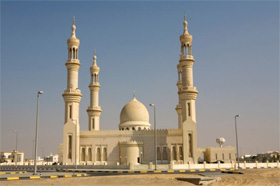 A mosque is the building in which Muslims worship God. Throughout
Islamic history, the mosque was the centre of the community and towns formed
around this pivotal building. Nowadays, especially in Muslim countries mosques
are found on nearly every street corner, making it a simple matter for Muslims to
attend the five daily prayers. In the West mosques are integral parts of Islamic
centers that also contain teaching and community facilities.
A mosque is the building in which Muslims worship God. Throughout
Islamic history, the mosque was the centre of the community and towns formed
around this pivotal building. Nowadays, especially in Muslim countries mosques
are found on nearly every street corner, making it a simple matter for Muslims to
attend the five daily prayers. In the West mosques are integral parts of Islamic
centers that also contain teaching and community facilities.
Mosques come in all shapes and sizes; they differ from region to region based on the density of the Muslim population in a certain area. Muslims in the past and even today have made use of local artisans and architects to create beautiful, magnificent mosques.
There are however, certain features that are common to all mosques. Every mosque has a mihrab, a niche in the wall that indicates the direction of Mecca; the direction towards which Muslims pray. Most mosques have a minbar (or pulpit) from which an Islamic scholar is able to deliver a sermon or speech.
Other common features include, minarets, tall towers used to call the congregation to prayer. Minarets are highly visible and are closely identified with mosques. Normally there is a large rectangular or square prayer area. It often takes the form of a flat roof supported by columns or a system of horizontal beams supported by architraves. In other common mosque designs, the roof consists of a single large dome on pendentives.[1] There are usually separate prayer areas, with separate entrances for both men and women.
Mosques have developed significantly over the past 1400 years. Many have courtyards containing decorative pools and fountains, which originally supplied water for ablution before prayer. Nowadays however, more private bathroom and toilet facilities are provided. Originally simple structures with earthen floors, now, mosque floors are usually covered with plush carpet. They are more often than not decorated with straight lines of geometric designs that ensure Muslims stand in straight rows to perform their five daily prayers.
There are never any images of life or statues in mosques, for in Islam it is forbidden that such things are kept or displayed. . At times, the interior walls of the mosque are decorated with verses from the Quran in Arabic calligraphy, or with intricate geometric designs. The patterns are made from a variety of materials including mosaics, stucco, stone, ceramics, and wood. The more classical designs are referred to as arabesque, and they take the form of a radial grid in which circle and star shapes are prominent. Designs can be both two, and three-dimensional.
More often than not, even in arid desert countries mosques are cool, serene havens. When a person enters a mosque he or she would have left the hustle and bustle of the material world and retreated into a calm shelter or sanctuary. Mosques are houses of worship. Men are expected to pray all five daily obligatory prayers in a mosque, in congregation. Although women are welcome to pray in the mosque it is more praiseworthy for them to pray in their homes. Nonetheless, Muslims are permitted to pray anywhere, excluding filthy or impure places such as toilets or in graveyards.Prophet Muhammad, may the mercy and blessings of God be upon him, said, “The entire earth was made a masjid for me”[2]. Masjid is the Arabic word for mosque. However, while the term mosque has come to mean a building specifically for prayer the word masjid has retained several layers of meaning.
In the very literal sense, masjid means place of prostration. The Arabic word comes from the root “sa-ja-da” meaning to prostrate. When a Muslim’s forehead touches the ground, he or she is close to God. Prayer establishes the connection between the believer and his Lord and prostration symbolises complete submission.
Many people have incorrectly stated that the word mosque is not a translation of the word masjid. They claim that the word mosque comes from the word mosquito and attribute it to Queen Isabella and King Ferdinand of 15th century Spain. However, the words mosque and mosquito are totally unrelated.
The word “mosque” was introduced into the English language in the late 14th or early 15th century from the French. It comes from the French word mosquée from the old French word mousquaie. The French, in turn, derived the word from the Italian word moschea from moscheta. The Italians got it either directly from the Arabic word masjid or from the old Spanish mesquita.[3]
Thus we can see that the translation of the Arabic word Masjid, into English becomes mosque. A mosque is a house of prayer, and a place of prostration. It is a building designed and built specifically for the worship of Allah. It is where Muslims stand shoulder to shoulder, united in their love for God and their desire to please Him.
Footnotes:
[1] Pendentives are an Islamic contribution to architecture that allow the placing of a circular dome over a square room or an elliptical dome over a rectangular room.
[2] Saheeh Al-Bukhari. Me is taken to mean - my nation.
[3] The American Heritage Dictionary of the English Language, Fourth Edition; © 2000 Houghton Mifflin Company.
Online Etymology Dictionary, http://www.etymonline.com/m8etym.htm