
The First Pillar of Islam: The Muslim Profession of Faith
Description: An introduction to the first pillar of Islam: the Muslim Profession of Faith, or the shahada, that no-one deserves worship except God, and Muhammad is the Messenger of God, and the various meanings they contain.
- By Imam Mufti
- Published on 13 Feb 2006
- Last modified on 25 Jun 2019
- Printed: 3,638
- Viewed: 482,935
- Rated by: 231
- Emailed: 79
- Commented on: 6


 All practicing Muslims accept belief in the ‘Six Articles
of Faith’ and are obliged to follow the ‘Five Pillars.’ They are:
All practicing Muslims accept belief in the ‘Six Articles
of Faith’ and are obliged to follow the ‘Five Pillars.’ They are:
1. Muslim profession of faith or shahada.
2. Ritual Prayer or salah.
3. Obligatory Charity or zakah.
4. Fasting or sawm.
5. Pilgrimage or hajj.
The First Pillar
Muslim Profession of Faith
The Shahada is the Muslim profession of faith and the first of the ‘Five Pillars’ of Islam. The word shahada in Arabic means ‘testimony.’ The shahada is to testify to two things:
(a) Nothing deserves worship except God (Allah).
(b) Muhammad is the Messenger of God (Allah).
A Muslim is simply one who bears witness and testifies that "nothing deserves worship except God and Muhammad is the messenger of God." One becomes a Muslim by making this simple declaration.
It must be recited by every Muslim at least once in a lifetime with a full understanding of its meaning and with an assent of the heart. Muslims say this when they wake up in the morning, and before they go to sleep at night. It is repeated five times in the call to prayer in every mosque. A person who utters the shahada as their last words in this life has been promised Paradise.
Many people ignorant of Islam have misconceived notions about the Allah, used by Muslims to denote God. Allah is the proper name for God in Arabic, just as "Elah", or often "Elohim", is the proper name for God in Aramaic mentioned in the Old Testament. Allah is also His personal name in Islam, as "YHWH" is His personal name in Judaism. However, rather than the specific Hebrew denotation of "YHWH" as "He Who Is", in Arabic Allah denotes the aspect of being "The One True Deity worthy of all worship". Arabic speaking Jews and Christians also refer to the Supreme Being as Allah.
(a) Nothing deserves worship except God (Allah).
The first part of this testimony states that God has the exclusive right to be worshipped inwardly and outwardly, by one’s heart and limbs. In Islamic doctrine, not only can no one be worshipped apart from Him, absolutely no one else can be worshipped along with Him. He has no partners or associates in worship. Worship, in its comprehensive sense and all its aspects, is for Him alone. God’s right to be worshipped is the essential meaning of Islam’s testimony of faith: Lā ‘ilāha ‘illā Allāh. A person becomes Muslim by testifying to the divine right to worship. It is the crux of Islamic belief in God, even all of Islam. It is considered the central message of all prophets and messengers sent by God - the message of Abraham, Isaac, Ishmael, Moses, the Hebrew prophets, Jesus, and Muhammad, may the mercy and blessings of God be upon them. For instance, Moses declared:
"Hear, O Israel The Lord our God is one Lord." (Deuteronomy 6:4)
Jesus repeated the same message 1500 years later when he said:
"The first of all the commandments is, "Hear, O Israel; the Lord our God is one Lord." (Mark 12:29)
…and reminded Satan:
"Away from me, Satan! For it is written: Worship the Lord your God, and serve Him only." (Matthew 4:10)
Finally, the call of Muhammad, some 600 years after Jesus, reverberated across the hills of Mecca, ‘And your God is One God: there is no god but He.’ (Quran 2:163). They all declared clearly:
"Worship God! You have no other god but Him." (Quran 7:59, 7:73; 11:50, 11:84; 23:32)
But by a mere verbal profession alone, one does not become a complete Muslim. To become a complete Muslim one has to fully carry out in practice the instruction given by Prophet Muhammad as ordained by God. This brings us to the second part of the testimony.
(b) Muhammad is the Messenger of God (Allah).
Muhammad was born in Mecca in Arabia in the year 570 CE. His ancestry goes back to Ishmael, a son of Prophet Abraham. The second part of the confession of faith asserts that he is not only a prophet but also a messenger of God, a higher role also played by Moses and Jesus before him. Like all prophets before him, he was a human being, but chosen by God to convey His message to all humanity rather than one tribe or nation from among the many that exist. For Muslims, Muhammad brought the last and final revelation. In accepting Muhammad as the "last of the prophets," they believe that his prophecy confirms and completes all of the revealed messages, beginning with that of Adam. In addition, Muhammad serves as the preeminent role model through his life example. The believer’s effort to follow Muhammad’s example reflects the emphasis of Islam on practice and action.
The Second Pillar of Islam: The Prayer
Description: An introduction to the second pillar of Islam, the Ritual Prayer, its spiritual dimensions, the Adhan (the ‘Call to Prayer’), and the Friday Prayer (Jumuah).
- By Imam Mufti
- Published on 16 Jan 2006
- Last modified on 25 Jun 2019
- Printed: 3,864
- Viewed: 457,730
- Rated by: 268
- Emailed: 87
- Commented on: 11
Salah is the daily ritual prayer enjoined upon all Muslims as one of the five Pillars of Islam. It is performed five times a day by all Muslims. Salah is a precise worship, different from praying on the inspiration of the moment. Muslims pray or, perhaps more correctly, worship five times throughout the day:
·Between first light and sunrise.
·After the sun has passed the middle of the sky.
·Between mid-afternoon and sunset.
·Between sunset and the last light of the day.
·Between darkness and midnight.
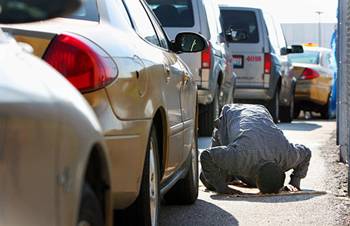
Abdullahi Haji-Mohamed kneels during evening prayers while waiting for fares at Cleveland Hopkins International Airport, May 4, 2005. (AP Photo/The Plain Dealer, Gus Chan)
Each prayer may take at least 5 minutes, but it may be lengthened as a person wishes. Muslims can pray in any clean environment, alone or together, in a mosque or at home, at work or on the road, indoors or out. Under special circumstances, such as illness, journey, or war, certain allowances in the prayers are given to make their offering easy.
Having specific times each day to be close to God helps Muslims remain aware of the importance of their faith, and the role it plays in every part of life. Muslims start their day by cleaning themselves and then standing before their Lord in prayer. The prayers consist of recitations from the Quran in Arabic and a sequence of movements: standing, bowing, prostrating, and sitting. All recitations and movements express submission, humility, and homage to God. The various postures Muslims assume during their prayers capture the spirit of submission; the words remind them of their commitments to God. The prayer also reminds one of belief in the Day of Judgment and of the fact that one has to appear before his or her Creator and give an account of their entire life. This is how a Muslim starts their day. In the course of the day, Muslims dissociate themselves from their worldly engagements for a few moments and stand before God. This brings to mind once again the real purpose of life.
These prayers serve as a constant reminder throughout the day to help keep believers mindful of God in the daily stress of work, family, and distractions of life. Prayer strengthens faith, dependence on God, and puts daily life within the perspective of life to come after death and the last judgment. As they prepare to pray, Muslims face Mecca, the holy city that houses the Kaaba (the ancient place of worship built by Abraham and his son Ishmael). At the end of the prayer, the shahada (testimony of faith) is recited, and the greeting of peace, "Peace be upon all of you and the mercy and blessings of God," is repeated twice.
Though individual performance of salah is permissible, collective worship in the mosque has special merit and Muslims are encouraged to perform certain salah with others. With their faces turned in the direction of the Kaaba in Mecca, the worshipers align themselves in parallel rows behind the imam, or prayer leader, who directs them as they execute the physical postures coupled with Quran recitations. In many Muslim countries, the "call to prayer," or ‘Adhan,’ echo out across the rooftops. Aided by a megaphone the muezzin calls out:
Allahu Akbar (God is the greatest),
Allahu Akbar (God is the greatest),
Allahu Akbar (God is the greatest),
Allahu Akbar (God is the greatest),
Ash-hadu an-laa ilaaha il-lal-lah (I witness that none deserves worship except God).
Ash-hadu an-laa ilaaha il-lal-lah (I witness that none deserves worship except God).
Ash-hadu anna Muhammadar-Rasool-ullah (I witness that Muhammad is the messenger of God).
Ash-hadu anna Muhammadar-Rasool-ullah (I witness that Muhammad is the messenger of God).
Hayya ‘alas-Salah (Come to prayer!)
Hayya ‘alas-Salah (Come to prayer!)
Hayya ‘alal-Falah (Come to prosperity!)
Hayya ‘alal-Falah (Come to prosperity!)
Allahu Akbar (God is the greatest),
Allahu Akbar (God is the greatest),
La ilaaha il-lal-lah (None deserves worship except God).
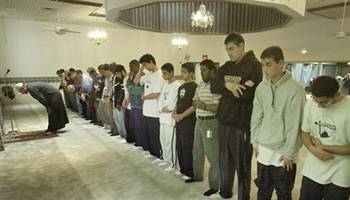
Men are joined by some of the students from the Noor-ul-Iman School for afternoon prayer at the Islamic Society of New Jersey, a mosque in suburban South Brunswick, N.J., Tuesday, May 13, 2003. Many Muslims communities across the United States are spreading out from the cities to the suburbs. (AP Photo/Daniel Hulshizer)
Friday is the weekly day of communal worship in Islam. The weekly convened Friday Prayer is the most important service. The Friday Prayer is marked by the following features:
·It falls in the same time as the noon prayer which it replaces.
·It must be performed in a congregation led by a prayer leader, an ‘Imam.’ It can not be offered individually. Muslims in the West try to arrange their schedules to allow them time to attend the prayer.
·Rather than a day of rest like the Sabbath, Friday is a day of devotion and extra worship. A Muslim is allowed normal work on Friday as on any other day of the week. They may proceed with their usual activities, but they must break for the Friday prayer. After the worship is over, they can resume their mundane activities.
·Typically, the Friday Prayer is performed in a mosque, if available. Sometimes, due to unavailability of a mosque, it may be offered at a rented facility, park, etc.
·When the time for prayer comes, the Adhan is pronounced. The Imam then stands facing the audience and delivers his sermon (known as khutba in Arabic), an essential part of the service of which its attendance is required. While the Imam is talking, everyone present listens to the sermon quietly till the end. Most Imams in the West will deliver the sermon in English, but some deliver it in Arabic. Those who deliver it in Arabic usually deliver a short speech in the local language before the service.
·There are two sermons delivered, one distinguished from the other by a brief sitting of the Imam. The sermon is commenced with words of praise of God and prayers of blessing for Prophet Muhammad, may the mercy and blessings of God be upon him.
·After the sermon, the prayer is offered under the leadership of the Imam who recites the Fatiha and other Quranic passages in an audible voice.
Special, large congregational prayers, which include a sermon, are also offered at late morning on the two days of festivity. One of them is immediately following the month of fasting, Ramadan, and the other after the pilgrimage, or hajj.
Although not religiously mandated, individual devotional prayers, especially during the night, are emphasized and are a common practice among pious Muslims.
The Third Pillar of Islam: Compulsory Charity
Description: An introduction to the third pillar of Islam, the compulsory charity or zakat, the spiritual dimensions of zakat and charity, and how Islam views money in general.
- By Imam Mufti
- Published on 16 Jan 2006
- Last modified on 04 Dec 2025
- Printed: 4,259
- Viewed: 511,247
- Rated by: 228
- Emailed: 50
- Commented on: 5
 Charity is not just recommended by Islam, it is required
of every financially stable Muslim. Giving charity to those who deserve it is
part of Muslim character and one of the Five Pillars of Islamic practice. Zakat
is viewed as "compulsory charity"; it is an obligation for those who have
received their wealth from God to respond to those members of the community in
need. Devoid of sentiments of universal love, some people know only to hoard wealth
and to add to it by lending it out on interest. Islam’s teachings are the very
antithesis of this attitude. Islam encourages the sharing of wealth with
others and helps people to stand on their own and become productive members of
the society.
Charity is not just recommended by Islam, it is required
of every financially stable Muslim. Giving charity to those who deserve it is
part of Muslim character and one of the Five Pillars of Islamic practice. Zakat
is viewed as "compulsory charity"; it is an obligation for those who have
received their wealth from God to respond to those members of the community in
need. Devoid of sentiments of universal love, some people know only to hoard wealth
and to add to it by lending it out on interest. Islam’s teachings are the very
antithesis of this attitude. Islam encourages the sharing of wealth with
others and helps people to stand on their own and become productive members of
the society.
In Arabic it is known as zakat which literally means "purification", because zakat is considered to purify one’s heart of greed. Love of wealth is natural and it takes firm belief in God for a person to part with some of his wealth. Zakat must be paid on different categories of property — gold, silver, money; livestock; agricultural produce; and business commodities — and is payable each year after one year’s possession. It requires an annual contribution of 2.5 percent of an individual’s wealth and assets.
Like prayer, which is both an individual and communal responsibility, zakat expresses a Muslim’s worship of and thanksgiving to God by supporting those in need. In Islam, the true owner of things is not man, but God. Acquisition of wealth for its own sake, or so that it may increase a man’s worth, is condemned. Mere acquisition of wealth counts for nothing in the sight of God. It does not give man any merit in this life or in the hereafter. Islam teaches that people should acquire wealth with the intention of spending it on their own needs and the needs of others.
"‘Man’, said the Prophet, ‘says: My wealth! My wealth!’ Have you not any wealth except that which you give as alms and thus preserve, wear and tatter, eat and use up?"
The whole concept of wealth is considered in Islam as a gift from God. God, who provided it to the person, made a portion of it for the poor, so the poor have a right over one’s wealth. Zakat reminds Muslims that everything they have belongs to God. People are given their wealth as a trust from God, and zakat is intended to free Muslims from the love of money. The money paid in zakat is not something God needs or receives. He is above any type of dependency. God, in His boundless mercy, promises rewards for helping those in need with one basic condition that zakat be paid in the name of God; one should not expect or demand any worldly gains from the beneficiaries nor aim at making one’s name as a philanthropist. The feelings of a beneficiary should not be hurt by making him feel inferior or reminding him of the assistance.
Money given as zakat can only be used for certain specific things. Islamic Law stipulates that alms are to be used to support the poor and the needy, to free slaves and debtors, as specifically mentioned in the Quran (9:60). Zakat, which developed fourteen hundred years ago, functions as a form of social security in a Muslim society.
Neither Jewish nor Christian scriptures praise slave manumission by raising it to worship. Indeed, Islam is unique in world religions in requiring the faithful to financially help slaves win their freedom and has raised the manumission of a slave to an act of worship - if it is done to please God.
Under the caliphates, the collection and expenditure of zakat was a function of the state. In the contemporary Muslim world, it has been left up to the individual, except in some countries in which the state fulfills that role to some degree. Most Muslims in the West disperse zakat through Islamic charities, mosques, or directly giving to the poor. Money is not collected during religious services or via collection plates, but some mosques keep a drop box for those who wish it to distribute zakat on their behalf. Unlike the zakat, giving other forms of charity in private, even in secret, is considered better, in order to keep one’s intention purely for the God.
Apart from zakat, the Quran and Hadeeth (sayings and actions of the Prophet Muhammad, may the mercy and blessings of God be upon him) also stress sadaqah, or voluntary almsgiving, which is intended for the needy. The Quran emphasizes feeding the hungry, clothing the naked, helping those who are in need, and the more one helps, the more God helps the person, and the more one gives, the more God gives the person. One feels he is taking care of others and God is taking care of him.
The Fourth Pillar of Islam: The Fast of Ramadan
Description: An introduction to the fourth pillar of Islam, the fast of Ramadan, its spiritual benefits, and the concept of fasting in world religions.
- By IslamReligion.com
- Published on 16 Jan 2006
- Last modified on 19 Apr 2020
- Printed: 3,068
- Viewed: 278,127
- Rated by: 211
- Emailed: 63
- Commented on: 4
 Fasting is not unique to the Muslims. It has been
practiced for centuries in connection with religious ceremonies by Christians,
Jews, Confucianists, Hindus, Taoists, and Jains. God mentions this fact in the
Quran:
Fasting is not unique to the Muslims. It has been
practiced for centuries in connection with religious ceremonies by Christians,
Jews, Confucianists, Hindus, Taoists, and Jains. God mentions this fact in the
Quran:
“O you who believe, fasting is prescribed for you as it was prescribed for those before you, that you may develop God-consciousness.” (Quran 2:183)
Some Native American societies fasted to avert catastrophe or to serve as penance for sin. Native North Americans held tribal fasts to avert threatening disasters. The Native Americans of Mexico and the Incas of Peru observed penitential fasts to appease their gods. Past nations of the Old World, such as the Assyrians and the Babylonians, observed fasting as a form of penance. Jews observe fasting as a form of penitence and purification annually on the Day of Atonement or Yom Kippur. On this day neither food nor drink is permitted.
Early Christians associated fasting with penitence and purification. During the first two centuries of its existence, the Christian church established fasting as a voluntary preparation for receiving the sacraments of Holy Communion and baptism and for the ordination of priests. Later, these fasts were made obligatory, as others days were subsequently added. In the 6th century, the Lenten fast was expanded to 40 days, on each of which only one meal was permitted. After the Reformation, fasting was retained by most Protestant churches and was made optional in some cases. Stricter Protestants, however, condemned not only the festivals of the church, but its traditional fasts as well.
In the Roman Catholic Church, fasting may involve partial abstinence from food and drink or total abstinence. The Roman Catholic days of fasting are Ash Wednesday and Good Friday. In the United States, fasting is observed mostly by Episcopalians and Lutherans among Protestants, by Orthodox and Conservative Jews, and by Roman Catholics.
Fasting took another form in the West: the hunger strike, a form of fasting, which in modern times has become a political weapon after being popularized by Mohandas Gandhi, leader of the struggle for India’s freedom, who undertook fasts to compel his followers to obey his precept of nonviolence.
Islam is the only religion that has retained the outward and spiritual dimensions of fasting throughout the centuries. Selfish motives and desires of the base self alienate a man from his Creator. The most unruly human emotions are pride, avarice, gluttony, lust, envy, and anger. These emotions by their nature are not easy to control, thus a person must strive hard to discipline them. Muslims fast to purify their soul, it puts a bridle on the most uncontrolled, savage human emotions. People have gone to two extremes with regard to them. Some let these emotions steer their life which lead to barbarism among the ancients, and crass materialism of consumer cultures in modern times. Others tried to deprive themselves completely of these human traits, which in turn led to monasticism.
The fourth Pillar of Islam, the Fast of Ramadan, occurs once each year during the 9th lunar month, the month of Ramadan, the ninth month of the Islamic calendar in which:
“…the Quran was sent down as a guidance for the people.” (Quran 2:185)
God in His infinite mercy has exempt the ill, travelers, and others who are unable from fasting Ramadan.
Fasting helps Muslims develop self-control, gain a better understanding of God’s gifts and greater compassion towards the deprived. Fasting in Islam involves abstaining from all bodily pleasures between dawn and sunset. Not only is food forbidden, but also any sexual activity. All things which are regarded as prohibited is even more so in this month, due to its sacredness. Each and every moment during the fast, a person suppresses their passions and desires in loving obedience to God. This consciousness of duty and the spirit of patience helps in strengthening our faith. Fasting helps a person gain self-control. A person who abstains from permissible things like food and drink is likely to feel conscious of his sins. A heightened sense of spirituality helps break the habits of lying, staring with lust at the opposite sex, gossiping, and wasting time. Staying hungry and thirsty for just a day’s portion makes one feel the misery of the 800 million who go hungry or the one in ten households in the US, for example, that are living with hunger or are at risk of hunger. After all, why would anyone care about starvation if one has never felt its pangs oneself? One can see why Ramadan is also a month of charity and giving.
At dusk, the fast is broken with a light meal popularly referred to as iftaar. Families and friends share a special late evening meal together, often including special foods and sweets served only at this time of the year. Many go to the mosque for the evening prayer, followed by special prayers recited only during Ramadan. Some will recite the entire Quran as a special act of piety, and public recitations of the Quran can be heard throughout the evening. Families rise before dawn to take their first meal of the day, which sustains them until sunset. Near the end of Ramadan Muslims commemorate the “Night of Power” when the Quran was revealed. The month of Ramadan ends with one of the two major Islamic celebrations, the Feast of the Breaking of the Fast, called Eid al-Fitr. On this day, Muslims joyfully celebrate the completion of Ramadan and customarily distribute gifts to children. Muslims are also obliged to help the poor join in the spirit of relaxation and enjoyment by distributing zakat-ul-fitr, a special and obligatory act of charity in the form of staple foodstuff, in order that all may enjoy the general euphoria of the day.
The Fifth Pillar of Islam: The Pilgrimage (Hajj)
Description: The merits and various rites performed in Hajj, the fifth of the five obligatory fundamental Muslim practices.
- By Imam Mufti
- Published on 13 Feb 2006
- Last modified on 21 Apr 2026
- Printed: 3,113
- Viewed: 364,363
- Rated by: 255
- Emailed: 108
- Commented on: 24
_001.jpg) The Hajj (pilgrimage to Mecca) is the fifth of the
fundamental Muslim practices and institutions known as the five pillars of Islam.
Pilgrimage is not undertaken in Islam to the shrines of saints, to monasteries
for help from holy men, or to sights where miracles are supposed to have occurred,
even though we may see many Muslims do this. Pilgrimage is made to the Kaaba,
found in the sacred city of Mecca in Saudi Arabia, the ‘House of God,’ whose
sanctity rests in that the Prophet Abraham built it for the worship of God. God
rewarded him by attributing the House to himself, in essence honoring it, and
by making it the devotional epicenter which all Muslims face when offering the prayers
(salah). The rites of pilgrimage are performed today exactly as did by Abraham,
and after him by Prophet Muhammad, peace be upon them.
The Hajj (pilgrimage to Mecca) is the fifth of the
fundamental Muslim practices and institutions known as the five pillars of Islam.
Pilgrimage is not undertaken in Islam to the shrines of saints, to monasteries
for help from holy men, or to sights where miracles are supposed to have occurred,
even though we may see many Muslims do this. Pilgrimage is made to the Kaaba,
found in the sacred city of Mecca in Saudi Arabia, the ‘House of God,’ whose
sanctity rests in that the Prophet Abraham built it for the worship of God. God
rewarded him by attributing the House to himself, in essence honoring it, and
by making it the devotional epicenter which all Muslims face when offering the prayers
(salah). The rites of pilgrimage are performed today exactly as did by Abraham,
and after him by Prophet Muhammad, peace be upon them.
Pilgrimage is viewed as a particularly meritorious activity. Pilgrimage serves as a penance - the ultimate forgiveness for sins, devotion, and intense spirituality. The pilgrimage to Mecca, the most sacred city in Islam, is required of all physically and financially able Muslims once in their life. The pilgrimage rite begins a few months after Ramadan, on the 8th day of the last month of the Islamic year of Dhul-Hijjah, and ends on the 13th day. Mecca is the center towards which the Muslims converge once a year, meet and refresh in themselves the faith that all Muslims are equal and deserve the love and sympathy of others, irrespective of their race or ethnic origin. The racial harmony fostered by Hajj is perhaps best captured by Malcolm X on his historic pilgrimage:
"Every one of the thousands at the airport, about to leave for Jeddah, was dressed this way. You could be a king or a peasant and no one would know. Some powerful personages, who were discreetly pointed out to me, had on the same thing I had on. Once thus dressed, we all had begun intermittently calling out "Labbayka! (Allahumma) Labbayka!" (At your service, O Lord!) Packed in the plane were white, black, brown, red, and yellow people, blue eyes and blond hair, and my kinky red hair - all together, brothers! All honoring the same God, all in turn giving equal honor to each other . . .
That is when I first began to reappraise the ‘white man’. It was when I first began to perceive that ‘white man’, as commonly used, means complexion only secondarily; primarily it described attitudes and actions. In America, ‘white man’ meant specific attitudes and actions toward the black man, and toward all other non-white men. But in the Muslim world, I had seen that men with white complexions were more genuinely brotherly than anyone else had ever been. That morning was the start of a radical alteration in my whole outlook about ‘white’ men.
There were tens of thousands of pilgrims, from all over the world. They were of all colors, from blue-eyed blonds to black-skinned Africans. But we were all participating in the same ritual displaying a spirit of unity and brotherhood that my experiences in America had led me to believe never could exist between the white and the non-white... America needs to understand Islam, because this is the one religion that erases from its society the race problem. Throughout my travels in the Muslim world, I have met, talked to, and even eaten with people who in America would have been considered white - but the ‘white’ attitude was removed from their minds by the religion of Islam. I have never before seen sincere and true brotherhood practiced by all colors together, irrespective of their color."
Thus the pilgrimage unites the Muslims of the world into one international fraternity. More than two million persons perform the Hajj each year, and the rite serves as a unifying force in Islam by bringing followers of diverse backgrounds together in worship. In some Muslim societies, once a believer has made the pilgrimage, he is often labeled with the title ‘hajji’ ; this, however, is a cultural, rather than religious custom. Finally, the Hajj is a manifestation of the belief in the unity of God - all the pilgrims worship and obey the commands of the One God.
At certain stations on the caravan routes to Mecca, or when the pilgrim passes the point nearest to those stations, the pilgrim enters the state of purity known as ihram. In this state, the certain ‘normal’ actions of the day and night become impermissible for the pilgrims, such as covering the head, clipping the fingernails, and wearing normal clothing in regards to men. Males remove their clothing and don the garments specific to this state of ihram, two white seamless sheets that are wrapped around the body. All this increases the reverence and sanctity of the pilgrimage, the city of Mecca, and month of Dhul-Hijjah. There are 5 stations, one on the coastal plains northwest of Mecca towards Egypt and one south towards Yemen, while three lie north or eastwards towards Medina, Iraq and Najd. The simple garb signifies the equality of all humanity in God’s sight, and the removal of all worldly affections. After entering the state of ihram, the pilgrim proceeds to Mecca and awaits the start of the Hajj. On the 7th of Dhul-Hijjah the pilgrim is reminded of his duties, and the rituals commence on the 8th of the month. The pilgrim visits the holy places outside Mecca - Arafah, Muzdalifah, and Minaa - prays, sacrifices an animal in commemoration of Abraham’s sacrifice, throws pebbles at specific pillars at Minaa, and shortens or shaves his head. The rituals also involve walking seven times around the sacred sanctuary, or Kaaba, in Mecca, and ambulating, walking and running, seven times between the two small hills of Mt. Safaa and Mt. Marwah. Discussing the historical or spiritual significance of each rite is beyond the scope of this introductory article.
Apart from Hajj, the "minor pilgrimage" or umrah is undertaken by Muslims during the rest of the year. Performing the umrah does not fulfill the obligation of Hajj. It is similar to the major and obligatory Islamic pilgrimage (hajj), and pilgrims have the choice of performing the umrah separately or in combination with the Hajj. As in the Hajj, the pilgrim begins the umrah by assuming the state of ihram. They enter Mecca and circle the sacred shrine of the Kaaba seven times. He may then touch the Black Stone, if he can, pray behind the Maqam Ibrahim, drink the holy water of the Zamzam spring. The ambulation between the hills of Safa and Marwah seven times and the shortening or shaving of the head complete the umrah.


Add a comment